
Why a watery eye in a horse should never be ignored
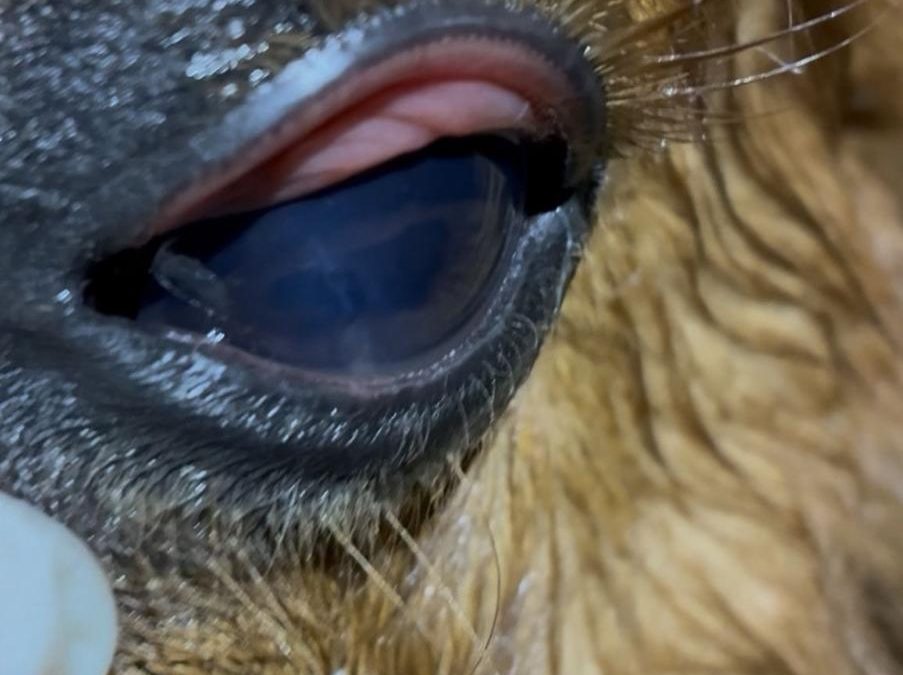
From the picture above, could you tell what was wrong with this eye?
At first glance, it looks fairly normal, doesn’t it?
This was a call-out to see a pony with what had been described as simply “a watery eye.” On initial examination, there really wasn’t a huge amount to see. The eye was slightly watery, but there was no dramatic swelling, obvious wound or anything immediately screaming emergency.
However, the pony’s heart rate was 60 beats per minute, which was considerably higher than we would expect at rest and suggested that something was causing pain or distress.
And when it comes to eyes, appearances can be very deceptive.
A little bit of stain tells a very different story…
Now look at the second picture.
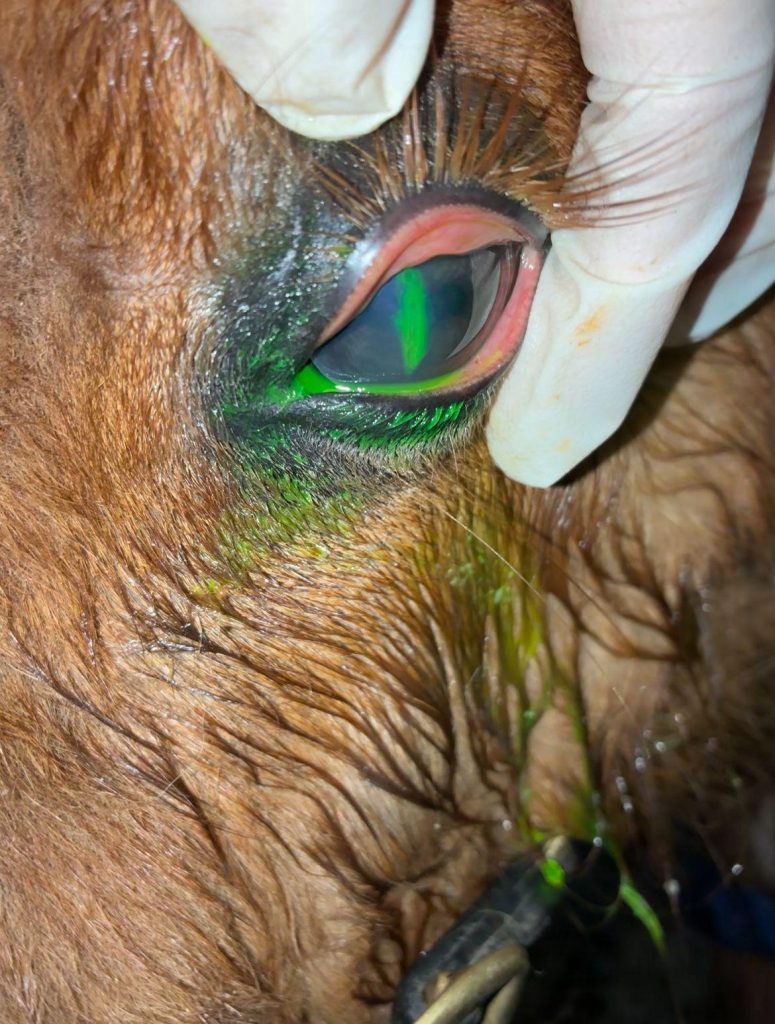
We applied fluorescein stain to the surface of the eye. This is a special dye that is taken up by areas where the surface of the cornea has been damaged.
Suddenly, our apparently fairly normal-looking eye told us a completely different story.
The yellowy-green area highlighted by the stain revealed a very long corneal ulcer.
In this pony’s case, we suspected that the ulcer had probably been caused by trauma while hedge browsing. A twig or piece of vegetation catching the surface of the eye may be all it takes.
And this is one of the problems with horses…
Those big beautiful eyes have a purpose
Horses have large, prominent eyes positioned towards the sides of their heads. In very simple terms: their eyes stick out!
There are some very good evolutionary reasons for this.
The upsides
They can see almost all the way around themselves.
Horses have an impressive panoramic field of vision, which is pretty useful when you’re a prey animal. It allows them to keep an eye out for approaching predators.
These days, the sabre-toothed tigers may have disappeared, but apparently dandelions, plastic bags, suspicious-looking rocks and wheelie bins remain a significant threat.
They’re also remarkably good in different light conditions.
The horse’s eye is adapted to function in both bright daylight and relatively low-light conditions. Their excellent night vision helps them detect movement and navigate when light levels fall.
This is another very useful survival mechanism.
Unfortunately, there is a downside to having those enormous, prominent eyes.
The downsides
Because the horse’s eyes are so exposed, they’re vulnerable to injury and irritation.
Branches and vegetation, dust, foreign bodies and blunt trauma can all cause problems. Their eyes are also continually exposed to environmental irritants such as wind, flies, dust and pollen.
Horses can therefore suffer from a range of eye conditions, including:
- Corneal ulcers
- Uveitis
- Conjunctivitis
- Foreign bodies
- Traumatic injuries
- Blocked or inflamed tear ducts
- Infections
- Squamous cell carcinoma and other growths such as sarcoids
Some of these conditions can initially look remarkably similar.
And that’s why a watery eye isn’t a diagnosis.
Ulcer or uveitis? Why it matters
One of the most important things we needed to establish in this case was whether the pony’s watery, painful eye was caused by a corneal ulcer or uveitis.
Both conditions can cause signs such as tearing, discomfort, squinting and sensitivity to light.
But they are very different conditions and the treatment required can be completely different.
Some medications that may be appropriate for one eye condition can potentially make another considerably worse.
That’s why we don’t recommend treating a painful or watery eye with leftover eye ointment from a previous episode—or medication that happened to work for somebody else’s horse.
We need to know what we’re treating first.
Treating this pony’s ulcer
In this particular case, the fluorescein stain confirmed that we were dealing with a corneal ulcer caused by trauma.
Treatment included plasma, produced from a blood sample taken from the pony’s jugular vein, combined with EDTA as part of the topical treatment.
The pony was also given flunixin for pain relief and inflammation, alongside a topical antibiotic—chloramphenicol in this case.
Treatment for eye ulcers isn’t identical for every horse. The size, depth, appearance and underlying cause of an ulcer all influence how we manage it, and some ulcers can become complicated surprisingly quickly.
Which brings us to the important bit…
Please don’t “just see how it is tomorrow”
Eye problems in horses are something we would much rather examine sooner rather than later.
Call us if you notice:
- A persistently watery eye
- Squinting or holding the eye partially closed
- Swelling around the eyelids
- Sensitivity to light
- A cloudy, blue or unusual appearance to the eye
- Yellow or green discharge
- Rubbing the eye
- An obvious injury
- A foreign body
- Or simply an eye that suddenly doesn’t look right
A horse can have a significant and painful eye problem without there being much to see from the outside—as this pony demonstrated perfectly.
Thankfully, when identified early and treated appropriately, many eye problems respond very well.
So, if you’re ever looking at your horse thinking…
“It’s only watering a little bit. Am I being silly calling the vet?”
No.
When it comes to eyes, we’d much rather come out and tell you everything looks okay than arrive later to find that a small problem has become a much bigger one.
Little Rock Equine Vets Ltd
We are the little rock upon which you lean, to get you back in the saddle.
📞 01782 898102