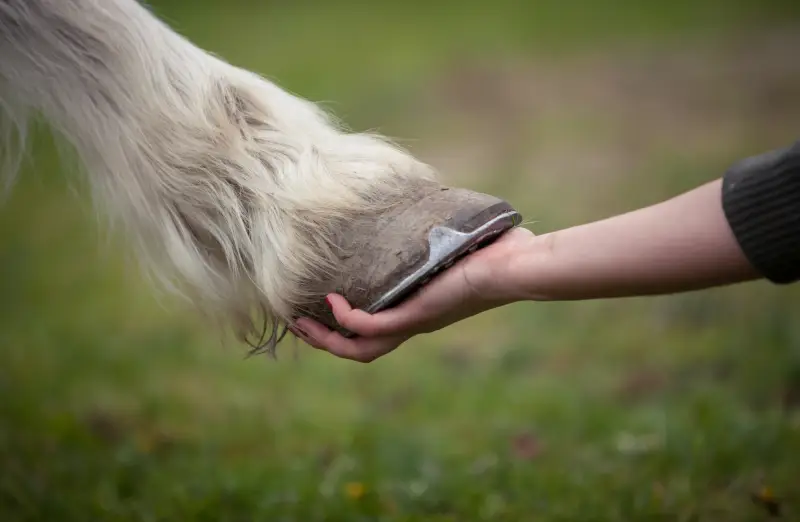
Your horse’s feet are the foundation of their whole body.
When hooves aren’t balanced, it’s a bit like you wearing one shoe with a higher heel than the other. You can still walk. You might even manage quite well for a while. But over time, things start to ache. Joints compensate. Muscles tighten. And eventually, something gives.
The same is true for horses.
At Little Rock Equine Vets, we regularly see performance issues and subtle lameness cases where hoof balance plays a much bigger role than first expected.
What Is Hoof Balance?
Hoof balance refers to how evenly your horse’s weight is distributed through the hoof capsule and internal structures.
A well-balanced hoof allows:
- Even weight bearing
- Straight limb alignment
- Correct breakover
- Reduced strain on joints and soft tissues
- Efficient, comfortable movement
When balance is off — even slightly — the effects travel upwards through the limb and into the body.
What Can Happen When Hooves Aren’t Balanced?
Imbalanced feet don’t always cause immediate dramatic lameness. Often, the signs are gradual and subtle.
Horses with poor hoof balance may develop:
- Sore feet
- Short, uneven steps
- Joint and tendon strain
- Back or shoulder pain
- Ongoing or recurring lameness
- Reduced performance
- Difficulty maintaining rhythm or straightness
Over time, uneven loading places excessive strain on certain structures. Tendons, ligaments and joints begin to compensate. Chronic strain can then lead to more complex lameness patterns.
Sometimes, hoof balance is the missing piece in horses that are described as “not quite right.”
Why What You See Isn’t Always the Full Story
From the outside, a hoof can appear neat and tidy. But what we see externally doesn’t always reflect what is happening internally.
That’s where radiography becomes incredibly valuable
How X-Rays Help Assess Hoof Balance
X-rays allow us to see beyond the hoof wall and into the structures that truly determine comfort and long-term soundness.
With radiographs, we can assess:
- How the bones sit inside the hoof capsule
- Alignment of the pedal bone
- Sole depth
- Whether weight is being carried evenly
- If breakover is positioned appropriately
- Where trimming or shoeing adjustments may help
This information gives both us and your farrier a clear, objective picture of the hoof’s internal structure.
Instead of working from guesswork or appearance alone, we can guide trimming and shoeing decisions based on evidence — improving comfort, performance and long-term protection.
Working Together: Vet and Farrier Collaboration
Good hoof balance is rarely achieved in isolation.
The best outcomes happen when veterinary assessment and farriery work together. By combining clinical examination with radiographic guidance, we can ensure that hoof shape and shoeing truly support the internal structures of the foot.
It’s about teamwork — all focused on one goal: your horse’s comfort.
The Long-Term Benefits of Good Hoof Balance
Correct hoof balance helps your horse:
- Move more comfortably
- Stay sound for longer
- Avoid preventable strain injuries
- Maintain better posture and muscle symmetry
- Perform more consistently
- Reduce the risk of recurring lameness
When the foundation is strong, everything above it functions better.
When Should You Consider a Hoof Balance Assessment?
You may want to explore hoof balance if your horse:
- Feels uneven or short in their stride
- Has recurring low-grade lameness
- Develops repeated tendon or joint strain
- Feels stiff in one direction
- Is struggling with performance despite correct training
- Has recently changed farrier or shoeing cycle
- Is coming back into work after injury
Sometimes the simplest explanation is the correct one — and hoof balance is often a logical starting point.
Supporting Your Horse From the Ground Up
If your horse seems sore, off, or just “not quite right,” hoof balance is a very sensible place to begin.
At Little Rock Equine Vets, we’re always happy to assess your horse and work alongside your farrier to ensure their feet are supporting them properly — from the ground up.
📞 01782 898102
Because when the foundation is right, everything else can follow.